
BEFORE THE WESTERN WASHINGTON GROWTH MANAGEMENT
HEARINGS BOARD
STATE OF WASHINGTON
TOWN OF FRIDAY HARBOR, FRED R. KLEIN,
FREDERICK E. ELLIS, JR., JOHN M. CAMPBELL,
AND LYNN BAHRYCH, et al.,
Petitioners, Case No. 99-2-0010c
v. BRIEF
San Juan County
Respondent,
and
JOE SYMONS, FRIENDS OF THE SAN JUANS, and
KAREN J. KEY SPECK, et al.,
Intervenors.
______________________________________________
Intervenor:
Joe Symons, Intervenor
3222 Point Lawrence Road
Olga WA 98279
360-376-4549
Fax 360-376-2626
Notation system for references:
Note: all references unless otherwise indicated refer to the San Juan County (SJC) Comprehensive Plan (CP). A Table of Authorities references all documents by index number referred to in the brief other than the CP. Index numbers for the CP are not in the Table of Authorities pursuant to SJC Prosecutor’s letter to WWGMHB of April 28, 1999, indicating that four complete copies of the CP and UDC have been forwarded to the board.
Table of Contents
Table of Authorities iii
1. Introduction 1
2. The Land Use element of the CP fails to meet GMA standards because the underlying information upon which it was constructed is inadequate. 3
2.1. The Land Use Element is deficient because the buildout analysis is deficient. 3
2.1.1 A Land Use element is a required component of GMA. 4
2.1.2 County Offers Buildout Analysis to meet
Land Use element requirement 5
2.1.3 County buildout analysis seriously flawed 5
2.1.4 Alternate buildout analysis which addresses weaknesses of SJC buildout analysis 12
2.1.5 Alternate growth rate analysis 20
2.2 The Land Use Element is deficient because there was inadequate public participation in the construction of the Land Use element. 22
3. The CP is not internally consistent. 24
3.1 Definitions and GMA Requirements regarding Internal Consistency. 25
3.2 Analysis of the Vision Statement 26
3.3 SEPA Comments on the Inconsistency Issue 30
3.4 SJC’s documentation acknowledges CP inconsistency 32
3.5 Internal Inconsistency as shown in the Land Use Element’s
Policy Section 2.2.A 35
4. Summary 38
5. Relief Sought 40
6. Exhibit 1 San Juan County Population Growth Chart 42
Table of Authorities
page numbers indicating the location of the reference
in the brief follow the document name
Indexed Documents Index Number
definition of "family" 39 UDC Section 2 Definitions, page 7
Final EIS 30 95151
petition 30 92565
population growth chart 20 (no index number from SJC to date)
Prosecutor, in a memo 33 170910
Resolution 60-1998 37 171883
Staff Report from the Planning Department to the BOCC 34 200374
Supplemental Environmental Impact Statement covering
the Shoreline Master Program 32 70096
Statutes and Regulations
RCW 36.70A.020 23, 24, 33
RCW 36.70A.020 (1) 12
RCW 36.70A.070 4, 25
RCW 36.70A.070 (5) 12
RCW 36.70A.110(2) 11
RCW 36.80A.070 (5) (b) 33
WAC 365-195-070 25
WAC 365-195-210 25, 26
WAC 365-195-300 26, 27
WAC 365-195-305 5
WAC 365-195-500 25
WAC 365-195-805 37
Definitions
CAC Citizen Advisory Committee
SC Steering Committee
1. Introduction:
I shall make the case that sections of the San Juan County (SJC) Comprehensive Plan (CP) should be invalidated and remanded to the County for further work. The case is based on a demonstration 1) that certain parts of the CP are inadequate, 2) other parts of the CP, built on or supported by the inadequate parts are therefore inadequate, and 3) the CP is internally inconsistent.
My case pertains to the following issues listed in the 99-2-0010c (III.10) pre-hearing order:
10. "Is the CP internally consistent and/or consistent with the adopted DRs?"
13. "Do any of the above allegations substantially interfere with the goals of the GMA?"
This brief sets out the following:
1) various GMA requirements and definitions, including the definition of internal consistency;
2) documentation that establishes that San Juan County (SJC) simply accepted wholesale, without adequate discussion or public participation, the land use densities which had been created by a pre-GMA Comprehensive Plan;
3) a demonstration that the buildout analysis, offered by SJC to fulfill GMA population projection requirements, is seriously flawed, rendering it inadequate, and thus rendering the Land Use Element, upon which the buildout analysis was provided as supporting information, deficient. I will further argue that SJC’s failure to create a defensible, adequate or even reasonable buildout analysis is prima facia evidence that the required public participation component for required elements–in this case the Land Use element–of GMA was ignored;
4) an analysis of the meaning of the Vision Statement in the context of the ultimate size and rate of change desired by the community;
5) SEPA comments demonstrating overwhelming public awareness of the significance of the inconsistency problem between the Vision Statement and the buildout population;
6) the presentation of documentation from the FEIS, SEIS, and Prosecutor’s Office acknowledging internal inconsistency in the CP; and
7) a review of the inconsistencies actually acknowledged and/or present in the policy section of the Land Use element of the CP.
Before I begin, I wish to frame the situation in its full context. Other petitioners raise density issues regarding the CP. For example, Bahrych et.al. is concerned with the guest house issue, while Klein is concerned about inconsistencies between existing densities and land use designations and associated density requirements for those designations. The core concern I raise here is best seen as an umbrella over these other, more specific, density-related issues.
The internal inconsistency claim I make is as follows: the Vision Statement describes the long term future we as a community have crafted and approved. The Vision Statement is the overall highest order policy statement of the CP. All other CP components, such as the Land Use element, are subordinate to the future of San Juan County as described by the Vision Statement. The totality of density descriptions as shown on the Official Maps represents a buildout population that is not just a little, but by a huge degree, inconsistent with–by GMA standards–the Vision Statement.
Approximately ten percent of the population of the entire County recognized the inconsistency problem and spoke forcefully about it during the SEPA comment period, virtually demanding that the County recognize and respond effectively to the problem. As will be shown, the County ignored this public expression. The Bottom Line is this: even if other, important and more tangible density issues are dealt with, such as the issues presented by the Bahrych and Klein petitions, SJC will still have failed to deal with "the Big Picture", which is to create a CP which truly enables and ennobles the Vision Statement, as required by GMA’s consistency standard. Correcting a few, or even a lot, of errant density vs. land use designation areas, and even repealing the guest house policy, will not solve the "Big Picture". Ensuring that "rural character " is met simply by ensuring that rural areas are no higher in density than 1 structure per 5 acres will not solve the "Big Picture". If the CP is to be internally consistent, the buildout population and associated impacts from the structures created to meet that population must conform to and meet the spirit of the Vision Statement.
In this brief, I will demonstrate that the actual buildout population for SJC is over 350% larger than the buildout projection offered by SJC. I will also demonstrate that the growth rate chosen by SJC for the buildout analysis is half of the actual historical growth rate and SJC’s use in that context is not justified by fact or law. I will further demonstrate that the buildout population is dramatically inconsistent with the Vision Statement and that SJC knew it or should have known it. According to GMA, SJC is required to craft a CP that not only meets specific density requirements for rural areas, it must meet as well the test presented by the Vision Statement. This is the "Big Picture" standard.
Here is my case.
2. The Land Use element of the CP fails to meet GMA standards because the underlying information upon which it was constructed is inadequate.
There are 2 reasons why the Land Use element of the CP is inadequate. First, the buildout analysis, upon which the Land Use element is based, is seriously flawed. Second, there was no public participation on the density considerations underlying the element.
2.1. The Land Use Element is deficient because the buildout analysis is deficient.
The arguments presented in subsection 2.1 are summarized as follows:
GMA requires a Land Use element. A required component of the land use element is an estimate of future population growth . A buildout analysis is offered by SJC in Appendix 1 of the CP to support the required estimate of future population growth. The buildout analysis offered by the County is deficient for the following reasons:
1) The buildout analysis omits population estimates attributable to:
the Town of Friday Harbor;
The Shoreline Master Program;
Guest houses per Land Use element 2.2.A.12;
2) The analysis uses undocumented and unspecified reduction factors to reduce the number of legal parcels;
3) The analysis includes occupancy ratios to reduce the buildout population. These ratios are not justifiable given the pattern of use they imply and given capital facilities requirements. The use of these ratios is not required by GMA;
4) The growth rate used in the buildout analysis is neither supported by GMA nor by local circumstances.
An alternative buildout analysis reveals a buildout population that is over 350% larger than the buildout population presented by SJC.
Conclusion: the required Land Use Element, which has been constructed using SJC’s buildout analysis, is deficient.
2.1.1 A Land Use element is a required component of GMA.
According to GMA, every CP must have a land use element.
RCW 36.70A.070 states that:
"Each comprehensive plan shall include a plan, scheme or design for each of the following:"
(I quote only part of the first following paragraph)
"(1) A land use element designating the proposed general distribution and general location and extent of the uses of land, where appropriate, for agriculture, timber production, housing, commerce, industry, recreation, open spaces, general aviation airports, public utilities, public facilities, and other land uses. The land use element shall include population densities, building intensities and estimates of future population growth " (emphasis mine).
The reader may also refer to WAC 365-195-305 Land Use Element requirements (b), which requires a county to offer an estimate of future population growth.
Note that the GMA does not limit the estimate of future population growth to the planning period. Consequently, this estimate is interpreted to mean the population growth at buildout.
2.1.2 County Offers Buildout Analysis to meet Land Use element requirement
The County uses a buildout analysis to support the CP; this analysis is presented in Appendix 1 of the CP. SJC defines "buildout analysis" (Appendix 1, section 3, subsection A., page 16) as:
"The buildout estimate that follows...simply tries to answer the question: what growth is possible given existing parcels, uses and the potential for creation of new parcels under the existing Comprehensive Plan designations and densities?"
This definition appears to mean that SJC defines "buildout" as the total legally possible population based on the land use densities on the Official Map. SJC has calculated 47,931 as the total buildout population in CP, Appendix 1, Table 20 "Total Buildout Population".
2.1.3 County buildout analysis seriously flawed
Several problems exist with SJC’s buildout analysis that render it dramatically flawed.
First, the buildout analysis omits parcels from large parts of SJC.
The CP states that "In the summary tables that follow, buildout is estimated for the entire county." The CP’s very next sentence, however, contradicts that assertion, by stating that "The buildout estimates included in this section do not reflect the densities associated with the Shoreline Master Program nor do they reflect the inability of some parcels to be developed as a result of site limitations." (emphasis is SJC’s) As it turns out, SJC’s estimate does not include the Town of Friday Harbor, either, a fact not noted directly by SJC. This omission will be demonstrated later. SJC offers no explanation why it limited its buildout analysis to the upland parcels only.
Second, the effect of the "guest house" policy, Land Use element 2.2.A 12, was ignored in the buildout analysis. This policy allows:
...one guest house (accessory dwelling unit) for each principal single-family residential use, the primary use of which will be for occupancy by family members, guests, or persons providing health care or property maintenance for the owner. Develop standards for guest houses to ensure that potential impacts on density, water, sewage disposal facilities and roads are mitigated. As an affordable housing opportunity, the long-term rental of guest houses may be allowed.(emphasis SJC).
This policy effectively doubles the number of structures that may be constructed and occupied on each existing and/or potential parcel in SJC. The record shows that SJC’s buildout projection, Table 20 and the assumptions and tables upon which it is based, do not discuss or calculate any additional population due to this policy. The CP specifically notes:
"The density calculations don’t include accessory units such as guest houses."
Although not directly related to this section on buildout analysis, it must be noted that this policy effectively upzones the entire County 100%, although there was no change in the Official Maps to reflect this density change. The Land Use element’s entire rural concept has been significantly changed. Every parcel, existing or potential, that has a zoning of one dwelling unit per 5 acres (or less), the minimum standard for rural, is now effectively one dwelling unit per 2.5 acres (or less), rendering about 80% of what was considered minimally "rural" upland SJC out of compliance with fundamental GMA planning goals, e.g., avoid rural sprawl. Only those upland parcels that have a density designation of R-10 (one dwelling unit per 10 acres) or higher now qualify as rural.
Third, SJC uses "reduction factors" in the buildout analysis that it does not explain satisfactorily.
SJC provides the total number of legal upland parcels in Table 18 of Appendix 1. To these numbers SJC applies "reduction factors". Page 20 of Appendix 1. SJC argues that this reduced number is representative of the total number of upland parcels likely to be developed, to wit:
"Other "reduction factors" can be applied to potential parcels to determine the number of likely sub dividable parcels as well. Not all parcels that can be subdivided will be, simply because the owners choose not to. Over a 20-year planning period, in rural residential environments, 10-12 percent of all parcels are not subdivided due to market and other socioeconomic factors. Table 19 summarizes the total acreage, the number of existing parcels, and the potential parcels by district, adjusted not to include those lands which are unlikely to be developed."
No details as to how these reduction factors are calculated are offered. No references to possible supporting documentation are presented.
In addition, SJC suggests a 10-12 percent reduction in the above quoted paragraph. The actual reduction percentage used by SJC, however, is 17%. SJC does not present or demonstrate how it arrived at the 17% figure. I made the calculation as follows from data supplied in Appendix 1, to wit:
From Table 18, Subtotals, "Unincorporated County" we have 35,582 potential parcels.
From Table 19, Total, we have 29,653 potential parcels.
The ratio of 29,653 divided by 35,582 is .833. SJC asserts that only 83% of the total upland parcels are likely to be developed. Consequently, 17% of the upland parcels have been removed based on ‘reduction factors’.
SJC thus claims that 5929 (35,582 less 29,653) upland parcels won’t be developed. Using CP data of 2.25 persons per household, and assuming each parcel supports only one residence (i.e., none of these residences has a guest house), the "reduction factors" translate into 13,340 people, or over 1000 people more than the population of the entire County at the last official count (1995. See Table 1, page 1, Appendix 1). This is a lot of people who the County claims won’t live in only the upland areas based on unsupported criteria.
Fourth, SJC inappropriately uses occupancy ratios to reduce the buildout population. Use of such ratios is inappropriate because they ignore impacts.
Although not defined in or by the CP, the occupancy ratio appears to be defined as the percentage of the year that a home is occupied. The idea here is that if, for example, all homes are occupied on average only half of the year, the occupancy ratio would be 50%, and consequently the population of SJC containing that home should be discounted by half. The unstated assumption behind the occupancy ratio is that if people aren’t home, their impact(s) are zero. This assumption is flawed for two reasons. First, SJC can’t logically assume that all those people will always stay away half the year, i.e., that at every given moment of the year there will never be more than 50% of the resident population in the county. Second, from a public or capital facility perspective, if there is a habitable residence, SJC must provide the full complement of services. The roads have to be designed to meet peak traffic needs. The power company, the water utility, the ferry services, the grocery stores, the fire department and other public and quasi-public services have to design their systems to provide a full level of service, or be able to provide a full level of service, at any time, which means, at every time. If a house catches fire when unoccupied, it still requires fire suppression services, and so on.
The question, then, is whether the use of an occupancy ratio is appropriate from an "impact on SJC" perspective. A local water utility may have many of its members who have no structure as yet; they may be saving their membership for later. Other members may have a structure, but are only present in SJC on weekends. State law nevertheless requires that the utility have sufficient water to meet all memberships as if they all had structures and all were occupied full time year round.
The use of an occupancy ratio assumes that on every given day of a year, only a fraction (the occupancy ratio) of the population is present in SJC. This County has a summer peak population which includes not just tourists, but individuals who spend their summers, or summer weekends here. SJC does not demonstrate that its use of an occupancy ratio is supported by making the claim that on no day of the year does the actual population exceed the occupancy ratio population. Indeed, data from the CP suggests precisely the opposite. Section 2 of Appendix 1, "Peak Season Population Estimates" says in its opening statement:
"The following tables estimate peak season population by assuming that during the peak of the Summer season all available accommodations are occupied, that ten percent of the residents have one houseguest staying with them, and that, in addition, the four ferry-served islands have day visitors."
The clear implication of this statement is that all residents are present. There is no mention of occupancy ratios as applied to Table 7 ("Estimated Population and Dwelling Units, 1990-1995") nor do any of the 7 footnotes to this table mention any reduction in resident population due to occupancy ratios. Here is an example of SJC’s decision to not use an occupancy ratio in forecasting future peak population, making their use of an occupancy ratio in their buildout analysis less understandable, certainly less justifiable.
That SJC assumes that residents are present full time in the summer is also seen in the preface to Table 8 (page 8, Appendix 1) which notes:
"These tables identify all of the possible accommodations available to residents and visitors, and estimate the population resulting from 100 percent occupancy at 2.25 persons per household for dwelling units and two persons per unit for most other accommodations."
Here, SJC uses an occupancy ratio of 100% for an extended period of time, i.e., the "peak season".
SJC never defines "peak season". One might assume from the term "season" that the county means a three month period. We get a clue to the county’s definition of peak season through the narrative description to Table 13, presented on page 14, which states:
Table 13–Estimated Number of Day Visitors in Peak Season (August), 1993 (emphasis SJC)
From this we infer that to SJC, the peak season is the month of August, during which time SJC assumes the county’s residential structures are fully occupied.
My point is simply that the use of an occupancy ratio as a means of reducing buildout population should be based on a rational argument. SJC offers no argument for the use of occupancy ratios in its buildout analysis, the principal effect of which is to significantly lower the buildout population number. Occupancy ratios used by SJC are not insignificant. An unweighted average of the 3 occupancy ratios provided in the CP (and presented below) is 69.8%. This is effectively a 30% discount of the actual buildout population. Explanations about peak populations presented by SJC demonstrate that the county assumes full resident occupancy during the peak period, which is a minimum of one month long. Given capital facilities and public services requirements, SJC must provide adequate services during lengthy times when the county knows it’s residential structures are fully occupied. Clearly, a county which used occupancy ratios to lower its buildout population would be understating, in SJC’s case, almost a third, the impacts that the county must be prepared to handle. The GMA requirement for estimating future population growth says nothing about limiting future population by occupancy ratios [see RCW 36.70A.070 (1)]. Indeed, population estimates provided by SJC during the planning period (Appendix 1, Section 1 ("Population Projections"), subsection C "Office of Financial Management (OFM) Projections", pages 2-3) describe the county’s estimated future population based on cohort survival models which involve rates of fertility, mortality and migration. There is nothing mentioned by SJC about occupancy ratios in any discussion concerning SJC’s use of OFM projections, and those OFM projections are not characterized as being reduced by occupancy ratios.
Consequently, the use of occupancy ratios in calculating buildout populations is questionable at best. For purposes of intelligent planning, such use is self-defeating and inappropriate.
Fifth, SJC uses OFM growth rates inappropriately in its buildout analysis.
SJC’s CP states:
"As part of the requirements of the Growth Management Act, the county must address the population projections prepared by OFM. RCW 36.70A.110(2) states that "Based upon the growth management population projection made for the county by the office of financial management, the urban growth areas in the county shall include areas and densities sufficient to permit the urban growth that is projected to occur in the county for the succeeding twenty-year period." (emphasis mine). Appendix 1, Section 1, subsection C, page 2
I emphasized the terms "urban growth" because GMA specifically requires a county to use OFM population projections (and their inherent rates of growth) for urban growth areas. San Juan County is a rural county. It has one incorporated town that represents just under 20% of the entire county. There is no factual justification or authority for SJC to use OFM’s "urban growth" projections for its rural areas.
It is instructive to note that OFM projects (Table 6) at the end of the planning period a Friday Harbor population of 3039 out of a total county population of 20442, or 14.8%. That is, according to OFM, between 1990 and 2015 the proportion of the county’s population which is attributable to the only town, i.e., the only urban growth area, in the county drops from about 20% to about 15%. This tells us that the majority of the growth in the county projected by OFM during the planning period is being allocated by the County to the rural areas, which is in direct opposition to the fundamental purposes of GMA [One might look at, for example, RCW 36.70A.070 (5) "Rural element": (b) "...uses not characterized by urban growth" as well as (5) (c) (i) "containing or otherwise controlling rural development" or, of course, more fundamentally RCW 36.70A.020 (1): "Encourage development in urban areas..."]
SJC should use a growth rate for the rural element that makes sense, and they should document how they derived that rate. Further discussion on the growth rate is presented below.
2.1.4 Alternate buildout analysis which addresses weaknesses of SJC buildout analysis
I provide in this section an alternative buildout analysis to demonstrate how significantly SJC’s buildout analysis has understated the projected buildout population.
A review of the information presented in 5 separate tables included in Appendix 1 along with a variety of assumptions about the data reveals an alternate buildout population for SJC that meets SJC’s buildout definition. In summary, this alternative analysis shows a buildout population of 175274, which is over 17 times the 1990 population of 10035 stated in Table 1 of Appendix 1. I will argue later that this population figure is far far in excess of a population consistent with the Vision Statement.
I wish to emphasize that the alternate buildout population analysis provided below is calculated using only information and assumptions directly out of the CP, Appendix 1.
Reconciling critical assumptions for buildout analysis
Two fundamental issues are presented for clarification of key assumptions behind the analysis to follow. These are the "guest house" issue and the "summer peak population" issue.
Guest house assumption. As noted earlier, the CP allows each residence to construct, without density limitation, a guest house. The SEIS recognizes (see below) that this policy "doubles the density" of SJC. This translates into doubling the buildout population. Whether or not a particular property owner will or will not construct a guest house, the CP provides a legal basis for a guest house. Consequently, to follow the definition presented by SJC, the initial density-derived population will be doubled in the calculations below to reflect the additional population that would accrue to guest houses.
Summer peak population assumption. The CP "Buildout Analysis" (sections 3 and 4 of Appendix 1) ignores the inclusion of the "peak season population" in its buildout analysis entirely, even while it spends considerable time calculating the impact of this population (section 2 of Appendix 1). Everyone who lives here experiences the impact of "summer folks", whether they are visitors, guests or property owners who come to occupy their homes for some or all of the summer. SJC must provide infrastructure for these people, in terms of roads, water, overnight accommodations, emergency medical services, etc. Section 2 of Appendix 1, entitled "Peak Season Population Estimate", reveals (Table 14) that the Visitor population represents 55% of the total peak summer population. That is, for every resident, there are 1.2 visitors during the peak summer period. Another way of saying this is that, during the peak season, the population of the county more than doubles.
There is no legal requirement that visitors may construct residential structures, so although SJC feels acutely the impact of visitors during the peak season months, their presence does not contribute to the buildout population. Visitors nevertheless require SJC to provide capital facilities and services, from roads and ferry parking to ensuring through the public health department that adequate water and septic systems exist, to providing police, fire and medical emergency services. Visitors give the residents a glimpse of their future. Because the peak season population of SJC more than doubles, the residents experience a flavor for what the full time residential population will be "down the road".
However, even though visitors have a substantial impact on SJC, for purposes of the buildout analysis I will consider their population contribution to be zero. This is consistent with what SJC has apparently done in deriving CP Table 20, the only reference they present that describes the buildout population.
Assumptions used to calculate alternative buildout population estimate.
The following assumptions underlie the buildout analysis presented below. I have included relevant assumptions from CP Section 3 ("Buildout Analysis"), subsection A. ("Buildout Methodology"), page 17 of Appendix 1.
1. All parcels in SJC will be considered. That is, upland and shoreline parcels will be used in the calculations. In addition, parcels in the Town of Friday Harbor will be included. (Contrast with bullet 1, page 17, which excludes the shoreline parcels and, although it is not mentioned in the bullet, also excludes the Town of Friday Harbor.)
2. Acreage data is of variable accuracy. (see bullet 2, page 17)
3. The number of existing legal parcels per tax parcel number is an approximation (bullet 3, page 17).
4. The Assessor’s Use Code numbers are used as a basis for analysis and may not reflect all of the uses on a property (bullet 4, page 17).
5. The density calculations include accessory units such as guest houses. (Contrast with bullet 5, page 17, which excludes accessory dwelling units.)
6. With the exception of Eastsound Service Industrial land use designations, the scenarios assume that all new development will be residential and will occur at the specified densities, persons per household and with a 100% occupancy rate. (Contrast with bullet 6, page 17, which assumes occupancy rates less than 100%)
7. The number of persons per household and vacancy rates are by census division and may not necessarily accurately reflect the actual rate (sic) on any given island. (bullet 7, page 17)
8. It is assumed that the occupancy rate and the number of persons per household will remain the same as the 1990 Census; however, trends suggest that the occupancy rate is increasing and the number of persons per household is decreasing. (bullet 8, page 17) (emphasis mine).
9. There is no distinction between parcels which are buildable and those which may be unbuildable due to site limitations. (bullet 9, page 17)
10. Portions of potential parcels were included in the totals. (bullet 10, page 17)
Methodology
To make the alternative calculation computationally parallel to the buildout calculation provided by SJC (with the exceptions noted in the list of bullets above), it is necessary to review quickly the methodology used by SJC. All references cited below are from CP Appendix 1. First, SJC calculates the number of potential parcels that are available and performs the following calculations:
1. It reduces the total number of parcels by "reduction factors" which it claims creates a more realistic picture of "parcels likely to be developed". Parcels are determined by County political district (there are 3). The result is presented in Table 19.
2. It multiplies the net number of parcels calculated and shown in Table 19 by the persons per household factor of 2.25. See Section 3, subsection C ("Relationship between Parcels and Population"), page 21.
3. It multiplies the resulting population by the occupancy rates for each district. Those rates are presented in Section 3, subsection C ("Relationship between Parcels and Population"), page 21, Appendix 1, as follows:
Lopez Division, 59.1% (District 3)
Orcas Division, 70.8% (District 2)
San Juan Division, 79.6% (District 1)
4. It offers the resulting buildout population figures for upland parcels only in Table 20, page 21. The Table does not indicate that the Town of Friday Harbor (located in District 1) has been excluded from the calculations. However, an examination of Table 19 reveals that the parcel data for District 1 is labeled as follows: "(unincorp.)". I interpret this to mean that only unincorporated parcel data from District 1 is included in this Table. As the data in Table 19 is used directly to calculate the population figures in Table 20 (I verified these calculations), it follows that the buildout population of Friday Harbor has been omitted from Table 20.
My calculations, presented below, use essentially the same methodology as described above. The differences are:
1) Parcel data for the Town of Friday Harbor and for the shoreline are included in the calculations as well as the data from Table 19 (the upland parcels data);
2) Occupancy ratios are set to be 100%;
3) Population figures are doubled to account for the "guest house" population.
Alternate Buildout Analysis
2.1.4.1 From Table 19, we find that the potential parcels (column 3) for the 3 districts, not including Friday Harbor, are as follows:
Designation Potential Parcels
District 1 12295
District 2 10749
District 3 6609
Total 29,653
2.1.4.2 From Table 18, page 20, column 3 (in the "Subtotals" area of the table) we find the potential parcels for Friday Harbor:
Designation Potential Parcels
Friday Harbor 2506
2.1.4.3 From Table 22, pages 26-29, column 6 (in the "Subtotals" area for each district in the table) we find the potential shoreline parcels by District::
Designation Potential Shoreline Parcels
Dist 1 2932
Dist 2 2425
Dist 3 2834
Total 8191
Note that the figures presented for the upland potential parcels by SJC are parcels "likely to be developed". As discussed earlier, SJC has reduced these numbers by various unspecified "reduction factors" which amount, overall for the upland parcels, to about 17%.
Since SJC offers no reduction factors for the Shoreline parcels, and given that the shoreline is the most desirable area of SJC and most likely to be developed even under difficult topographic conditions, I apply no reduction factor to the shoreline parcel data. Consequently, the assumption here is that all shoreline parcels will be developed.
2.1.4.4 The total potential parcels, then, for SJC are calculated as follows:
Uplands
District 1 12295
District 2 10749
District 3 6609
Friday Harbor
2506Shoreline
District 1 2932
District 2 2425
District 3 2834
Total 40350
SJC recognizes that it may have double counted some parcels in the shoreline area, so Table 23 estimates the number of dwelling units (I will take a dwelling unit as a parcel) that should be discounted from the total due to double counting. The total "double-counted" parcels for SJC is presented, in Table 23, as 1400.
Consequently, we subtract 1400 parcels from the 40350 total shown above to reveal an adjusted county wide total of potential parcels of 38950.
2.1.4.5 To make the data more easily comparable to that provided by SJC, the information is reformatted by legislative district, as follows:
District 1
Uplands 12295
Friday Harbor 2506
Shoreline 2932
Total 17733
District 2
Uplands 10749
Shoreline 2425
Total 13174
District 3
Uplands 6609
Shoreline 2834
Total 9443
2.1.4.6 Given that each parcel may have a guest house, these district totals are now doubled. Since we are now dealing with potential structures and not strictly "parcels", I will use the term "Structures" instead of "parcels" in table 2.1.4.7 following.
Designation Single Residence With Guest House
District 1 17733 35466
District 2 13174 26348
District 3 9443 18886
2.1.4.7 Multiplying each District total by an occupancy rate of 1.0 (100%) and CP defined 2.25 persons per household, we obtain:
Designation Occupancy ratio "Structures" persons/hhld Population
District 1 1.0 35466 2.25 79798
District 2 1.0 26348 2.25 59283
District 3 1.0 18886 2.25 42493
Total 181574
2.1.4.8 We estimate the population that is due to double counting as:
Designation Occupancy ratio "Structures" persons/hhld Population
Double counting 1.0 1400 2.25 3150
But, assuming each of these double-counted parcels could have a guest house, we double the population that is calculated, from 3150 to 6300. This number is to be subtracted from SJC total, to wit:
2.1.4.9 Total buildout population is: 181574
less double counting 6300
Total adjusted population 175274
We can verify this population estimate a second way. We take the total adjusted parcels, calculated earlier, of 38950 and double it for the guest house factor, to get 77900 potential structures in SJC. Each of these could have 2.25 people, to produce a countywide population of 175275. Rounding considerations explain the difference of 1 person in the two comparable buildout population estimates that have been calculated. SJC’s estimated buildout population, noted earlier, was 47,931. The buildout estimate presented here is 175275, which is 365% greater than SJC’s buildout estimate (175275 divided by 47931=365%).
SJC’s computational abilities are demonstrably competent, so why they chose not to complete the buildout analysis may not be a mystery. Their reasons for failing to complete the analysis may be speculated, but that is not our task. Had they included just the full set of parcels (the Town of Friday Harbor and the Shoreline), ignored the guest house issue and used occupancy ratios, all of which together would lower the population estimate I’ve offered here by more than half, the resulting number would still be many times larger than the existing population. Given their recognition, shown below, that they knew they were vulnerable to appeal on density issues, they may have chosen to lower their apparent profile by choosing to offer an incomplete buildout analysis stuck on a back page in an appendix. Their hat, though, was still above the trench, and I believe the record here shows that there are more than a few bullet holes in it.
2.1.5 Alternate growth rate analysis
Separate from the discussion of the buildout population is a discussion of the growth rate of SJC. Buildout tells us how big SJC will get; the growth rate tells us how quickly we will get there as well as how quickly we are changing. As will be presented in Section 3.2, below, on the Vision Statement, the rate of change, or growth rate, is an important element in my internal consistency case. An examination of the population growth chart which has been included as a supplement to the record and attached as an exhibit to this brief, shows 3 estimated growth rates for the planning period up to about 2020. Two of the 3 are about 2.5%; these are OFM’s estimated growth rate and SJC’s planning purposes growth rate. All data is from Appendix 1 of the CP. The 3rd growth rate shown on the graph is 5%, which came from SJISD No. 149 population projections and historical "baseline" data.
A brief examination of the exhibit shows a dramatic change in the apparent rate of growth of SJC starting in 1970. Appendix 1 of CP notes this in Section 1.D (SJC Housing Needs Assessment) paragraph 1 which states in part:
"As part of evaluating housing needs in San Juan County, the Madrona Group prepared population projections. It noted that in 1992 OFM’s population projection for SJC corresponded to an average annual growth rate of about 1.1 percent; but, that since county annual growth rates have been higher than 1.1 percent nearly every year since 1970, ..."
Indeed, although neither the CP nor the Appendix states it, a quick calculation of the actual growth rate between 1970 and 1993, using the OFM figures shown in Table 1 of Appendix 1, reveals that the average annual growth rate of SJC during this 23 year period is just over 5%.
The calculation is presented as follows:
1993 population 11,900
1970 population 3,856
Total Percentage growth 308% (11900 divided by 3856)
Annual percentage growth: 5% per year for 23 years, 1970-1993
Annual growth rate is calculated iteratively to answer the following question:
"what is the annual growth rate, when compounded each year over the total number of years, results in the overall growth between the start year and the end year?"
Algebraically, this can be expressed as:
308%=(1 plus annual growth rate)23
i.e., if the annual growth rate, here, 1.05 or 105%–corresponding to a 5% annual growth–is compounded (multiplied by itself) 23 times–representing the 23 year period between 1970 and 1993–the result will be an overall growth of 308%.
That is, since the growth spurt began in 1970, SJC has grown, on average, for over 2 decades, at 5%. Indeed, in the Introduction to the CP, Section 6.2 Summary of Existing Conditions, subsection Historic Population, the document states:
"...San Juan County’s population grew rapidly around the turn of the century, leveled off between 1920 and 1970, and then began to grow rapidly again after 1970. During the first three years of the 1990’s SJC experienced an average annual growth rate of 5.8 percent.
The point I wish to emphasize here is that although SJC is using projected growth rates of about 2.5% for the planning period out to 2015, the actual growth rate of SJC for more than two decades preceding the planning period of the CP has been around 5%. Consequently, the line illustrating the SJISD No. 149 projected growth rate of 5% may be a much more reliable, accurate and reasonable predictor of the likely growth rate of SJC than rates used by SJC. The opening section of Appendix 1, Section 3 Buildout Analysis (pg 16) states:
The buildout estimate that follows differ (sic) from the population forecasts of the previous section in that it is not based on historic trends. (emphasis mine).
The implication of this sentence is that those forecasts are based on historic trends.
Further, SJC tells us:
This method extrapolates based on past patterns established in a given time period. The time period (for example, 1960 to 1990) is referred to as the "baseline". The future growth is simply an illustration what would occur if the pattern of growth established in the baseline were continued. (Appendix 1, Section 1, subsection B, paragraph 2 (page 2) entitled "Baseline Projections")
As SJC acknowledges that "baseline projections" are in fact reasonable and acknowledged as a legitimate means for forecasting future population growth, the actual most recent historic trend can be justified, in the absence of any other acceptable argument, as a reasonable extrapolation.
Having accepted baseline projections as appropriate, SJC’s use of a 2.5% growth rate cannot be defended merely because it is within OFM’s range of growth rates. The record shows there is a baseline growth rate (1970 to 1993) of about 5%. The use of a 5% annual population growth rate results in population growth that is much higher at the end of the planning period than that forecast by OFM.
If we take the baseline 5% annual growth rate and start from the SJC’s 1990 population of 10,035, the 2020 population will be 43,371.
My point is simple: the population growth rate used by SJC is not supported by the law or by the evidence in the historic record supplied by the county. SJC is using a 20 year planning period. Using the more justifiable baseline annual population growth rate projection of 5%, the population at 2020 is over double (43,371 divided by 21,110) what SJC projects. Given that this difference in forecasts is far from trivial, SJC should be held to a much higher standard of accountability for the projected rural growth rate during the planning period.
2.2 The Land Use Element is deficient because there was inadequate public participation in the construction of the Land Use element.
Based upon the absence in the record regarding CAC and SC discussion of the density designation component of the Official Maps, one must conclude that SJC made a decision to remove such discussion of density changes from the arena of topics to be contemplated and decided by the CACs and the SC. The CP supports this conclusion up front. For example, the CP, Section 2.1.B Land Use Concept, paragraph 3, states:
The land use concept is based on the densities established under the 1979 Comprehensive Plan and focuses on the distribution and mix of land uses.
Indeed, the entire section 2.1.C Land Use Densities confirms this position:
"The land use densities established in 1979 as part of the original Comprehensive Plan have been retained in the Plan on the Official Maps..."
Had these 1979 pre-GMA comp plan densities been discussed, reviewed, debated and certified, they would have been characterized as 1998 densities.
The failure to discuss densities, thus perpetuating without comment decisions made prior to GMA, is not supported by Board rulings. In 95-3-0039c and 97-3-0024c (September 8, 1997), the CPSGMHB, page 2657, noted:
However, the advent of the GMA changed land use law in this state in a profound way, changing the land use patterns that counties may permit in rural areas. Kitsap County has attempted in its Plan to meet the Act’s requirements while including mechanisms to meet the history-based desires of some of its landowners. Pre-existing parcelization cannot be undone, however there is no reason to perpetuate the past (i.e., creation of an urban land use pattern in the rural area) in light of the GMA’s call for change. This axiom, recognized by the Board in the Bremerton FDO, remains true today:
The County cannot base its future planning for new growth on its past development practice if those practices, as here, do not comply with the GMA. What was once permissible is no longer so. The GMA was passed to stop repeating past mistakes in the future. Bremerton, at 71 [herein 1215].
San Juan County simply accepted wholesale, without public input, the land use densities which had been created by a pre-GMA Comprehensive Plan. GMA requires public participation for all required elements in the plan. RCW 36.70A.020, ("Planning Goals"), number (11) states:
"Citizen Participation and Coordination. Encourage the involvement of citizens in the planning process and ensure coordination between communities and jurisdictions to reconcile conflicts."
while RCW 36.70A.020 Planning Goal (2) states:
"Reduce sprawl. Reduce the inappropriate conversion of undeveloped land into sprawling, low density development."
My claim here is that the spirit of the public participation program and procedures was in fact violated by pre-empting a thorough discussion of densities within the formal structure of SJC’s citizen participation process [see RCW 36.70A.140]. Such failure to discuss densities violates planning goal 2. As such, the citizen participation requirement was not met.
That there was no public participation regarding densities in implicit in SJC’s inadequate buildout analysis, which serves as prima facia evidence that the public did not participate in reviewing the population forecasts supplied by SJC as a required component of the required land use element. As will be shown in section 3.3, below, there was substantial public comment regarding buildout concerns. Such a level of attention to this issue indicates the public’s unwillingness to tolerate, had there been public discussion on this topic, the kind of deficiencies that the County’s buildout analysis contains. In addition, there is no record presented in the CP showing public participation in discussing land use densities. Later sections of this brief provide further evidence that SJC knew it was deficient on the issue of allowable density and was vulnerable to appeal. This also serves as prima facia evidence that the density issue was not discussed. Had such discussions occurred, an attempted solution would have been crafted and presented in the CP and/or EIS reviews that demonstrated at least a good faith effort to meet, if nothing else, GMA planning goal 2.
3. The CP is not internally consistent.
I will show in this section that the CP is not internally consistent. My argument presents the relevant definitions and GMA requirements regarding internal consistency, an analysis of the Vision Statement contrasted with the buildout analysis presented earlier, a description of the SEPA comments on the inconsistency issue as seen by the citizens, documentation from the FEIS, the SEIS and the Prosecutor’s office that claim the CP is vulnerable to appeal and/or can’t be defended, and an analysis of the relevant policies from the CP’s Land Use element, section 2.2.A.
3.1 Definitions and GMA Requirements regarding Internal Consistency.
The GMA requirement for consistency is stated in RCW 36.70A.070, Comprehensive Plans, Mandatory elements, Paragraph 1:
"The Plan shall be an internally consistent document and all elements shall be consistent with the future land use map."
WAC 365-195-500 defines this as follows:
"Each comprehensive plan shall be an internally consistent document and all elements consistent with the future land use map. This means that each part of the plan should be integrated with all other parts and that all should be capable of implementation together. Internal consistency involves at least two aspects:
(1) Ability of physical aspects of the plan to coexist on the available land.
(2) Ability of the plan to provide that adequate public facilities are available when the impacts of development occur (concurrency).
Each plan should provide mechanisms for ongoing review of its implementation and adjustment of its terms whenever internal conflicts become apparent."
The CP offers no definition of consistency, so in that absence I will take guidance from WAC 365-195-210 ("Definitions"), which defines "consistency" as follows:
"Consistency" means that no feature of a plan or regulation is incompatible with any other feature of a plan or regulation. Consistency is indicative of a capacity for orderly integration or operation with other elements in a system.
Further guidance on the meaning of consistency is provided by WAC 365-195-070:
(7) Consistency. The act calls for "consistency" in a number of contexts. In general, the phrase "not incompatible with" conveys the meaning of "consistency" most suited to preserving flexibility for local variations. An important example of the use of the terms is the requirement that comprehensive plans be internally consistent. This requirement appears to mean that the parts of the plan must fit together so that no one feature precludes the achievement of any other. (E.g., the densities selected and the wetlands to be protected can both be achieved ion the available land base.)
I intend to show that the buildout population is inconsistent with the Vision Statement using the criteria that 1) "no one feature (of the CP) precludes the achievement of any other" and 2) "no feature of a plan or regulation is incompatible with any other feature of a plan".
3.2 Analysis of the Vision Statement
A Vision statement as a mandatory element of a CP derives directly from WAC 365-195-300 (Mandatory Elements) 2(e):
"The descriptive text covering objectives, principles and standards used to develop the comprehensive plan will be expressive of the vision of the future of the planning entity. The text should articulate community values derived from the visioning and other citizen participation processes. The terms objectives, principles and standards relate to methods chosen to meet planning goals or measurable steps on the path toward achieving such goals. The precise meaning of these terms should be locally defined."
WAC 365-195-210 defines "visioning" as follows:
"Visioning" means a process of citizen involvement to determine values and ideals for the future of a community and to transform those values and ideals into manageable and feasible community goals.
It is important to note that the RCW’s and WAC’s explicitly do not limit the visioning to the planning period. Indeed, WAC 365-195-300 (Mandatory Elements) number (2) "Recommendations for Overall Design", item (a) states:
"The planning horizon for the comprehensive plan should be at least the 20 year period following the adoption of the plan." (emphasis mine)
The Vision Statement, then, crafted by the CAC’s and the SC is for the "future". This is reinforced by the language used to conclude the Vision Statement, namely:
"As fortunate citizens of the San Juan Islands, we commit ourselves individually and communally to a future for ourselves and our children that reflects this vision." (emphasis mine).
The SJC CP demonstrates that SJC acknowledges its obligation to meet the WAC 365-195-300 requirement. In part, CP Introduction, page 1, Section 2 "Vision for the Future" states:
Visions allow people to dream and look into the future; they give us a chance to imagine what our community can become at its best.
Vision planning asks people from all walks of life to think about the future and what they would like it to become, and then figure out ways to make it happen. (emphasis mine).
In the simplest terms, a vision is a consensus image of what a community seeks to become. Adopted as a formal policy statement, a vision serves as both a blueprint for future direction and a yardstick against which to measure current decisions and actions.
Three Citizen Advisor Committees (CACs) representing a broad range of interests among the island communities were appointed by the Board of County Commissioners to guide SJC in revising its 1979 Comprehensive Plan. The first task of the CACs was to create a vision for the future...The County-wide Vision Statement was formally endorsed by the Board of County Commissioners in December 1993. The Vision Statement (Table 1) is the foundation upon which the entire Comprehensive Plan is based. (emphasis mine).
Note that there is no mention of a time horizon after which our Vision would sunset.
The entire Vision Statement is presented in the CP (Section A, Introduction) as Table 1 (pg 2). In the remainder of section 3.2, all references unless otherwise noted are to components of the one page Vision Statement. A reading of the Vision Statement conveys a sense of the future very much bound up in preserving a historically familiar quality of life that is rural, emphasizing the feeling of stewardship, visual openness, natural landscapes. The Preamble describes SJC as "rural islands" which are an "extraordinary treasure of natural beauty and abundance", whose occupants prize values of "privacy and personal freedom". The Community section describes a community that is "primarily rural", with islands which are "places of peace". The Basic Human Needs section describes islands where "all citizens can safely walk or play, day or night." The Economy section describes a desire to have a "pattern of economic growth and development" which "recognizes the rural, residential, quiet, agricultural, marine and isolated nature of the islands." The Economy section goes on to say "We support and encourage traditional industries including forestry, farming, aquaculture, construction, fishing and tourism without jeopardizing the resources on which they depend. (emphasis mine). The Natural Environment section states: "As careful stewards of these islands, we conserve resources, preserve open space, and take appropriate action to assure healthy land and marine environments."
The Land Use section states that "Neighborhoods, hamlets, villages and towns are clearly defined so as to conserve agricultural, forest, mineral resource and environmentally sensitive lands. These areas provide for commerce and community activities without losing their small scale and attractive island ambiance...Through innovative land use strategies, our citizens and institutions balance and protect private property rights, public rights and our natural environment."
The Vision Statement concludes with a statement in which those of use who live here "... commit ourselves individually and communally to a future for ourselves and our children that reflects this vision."
The Vision Statement must be seen not only for what it has in it, but what it doesn’t have in it. There is nothing in the Vision Statement that positions SJC as aspiring to become an Anacortes, a Mt. Vernon, or even a high end tourist community like Aspen or Marthas Vineyard. It seems clear that the vision describes an aspiration toward a future community which would be small, rural, slow paced, quiet, peaceful, friendly, and safe, i.e., pretty much like it always has been.
There are two qualities that emerge from the Vision Statement that need to be highlighted. The first might be called "size", the second might be called "rate of change". The "size" issue deals with how big the community wishes to become. The size issue is not spelled out in terms of the number, scale and location of activity centers or overall population–it must be inferred. The "sense" of this overall size, though, might be inferred by what is not said. There are no statements speaking to activity center augmentation. Instead, we have "small scale" and "island ambiance". Transportation is "commensurate with our island culture" and local transportation has a "system of scenic rural roads" that include "bicycle and pedestrian ways." Further, "In some places, the roads are unpaved, narrow and winding..." The Transportation Vision states that "Expansion or new construction of basic public transportation facilities occurs only on the basis of demonstrated local public need." That this statement is here at all suggests that only local need, not pre-planning or positioning for future out-of-county populations like visitors, should drive transportation improvements, and that need must be demonstrated, i.e., not assumed. The Heritage and Historic Preservation element also speaks to the sense of the "size" issue, to wit: "Our community is enriched by a strong sense of identity, tradition, legacy and continuity, where past and present freely mingle", going on to mention indigenous peoples, explorers and island pioneers. There is nothing here about bigness. The Community element of the Vision Statement states: "We foster a sense of neighborliness, of self-sufficiency, and community pride that has long been a part of our island character." These values generally characterize small, quaint, pretty-much-as-is places. The Economy section speaks of "home occupations and cottage industries which are compatible with surrounding neighborhoods." We are not talking steel mills here, or even light manufacturing. The size "flavor", then, is clearly small and by the absence of any references to growth, a reasonable person would conclude that the "island culture" and "ambiance" express keeping things more or less as they are.
The "rate of change" quality refers to the rate, speed or degree to which SJC wishes to change. Like the "size" quality, the "rate of change" quality must be inferred from the Vision Statement. The Vision Statement says "...citizens can safely walk or play, day or night." The statement did not say "safely drive". The islands are "places of peace". The islands are "quiet" and "isolated." This means "not noisy" and "not connected easily". Traditional industries are supported such as "forestry, farming, aquaculture, construction, fishing and tourism"; if you want slow paced, you think of people plowing fields with tractors or sitting in boats fishing or tourists kayaking. We are encouraged to be "careful stewards", normally characterized by slow, careful, and deliberate long term preservationist behaviors and activities. The derivation of "steward" is from Old English "keeper"–it originally comes from French "to guard" and before that from Latin "to respect." (American Heritage Dictionary) The CP talks of ensuring that some public roads are unpaved, scenic and windy, that we ensure bicycle and pedestrian paths–these qualities speak of slow rate of change. A reasonable person could infer that the community wishes to change slowly, if at all.
3.3 SEPA Comments on the Inconsistency Issue
The public has spoken on the specific issue of inconsistency between the Vision Statement and the buildout population during the official SEPA comment period from mid February to mid April 1995. The Final EIS (FEIS) published on October 2, 1996 by SJC contains the record of comments by the public. Of the 2090 total comments received regarding the CP, 1160 (55%) were on one topic, namely, signatures on a petition to require SJC to reconcile the internal inconsistency between the Vision Statement and the buildout population. The text from the petition reads as follows:
We undersigned residents of San Juan County support "A DECLARATION OF VISION AND COMMITMENT TO THE FUTURE OF SAN JUAN COUNTY" which calls for preserving our rural character, social diversity, and abundance of resources. Since continual development and population growth would destroy these values, we ask that you forthrightly determine the population that is consistent with the Vision Statement. Please include in the Comprehensive Plan equitable measures such as density reduction and development limitation, sufficient to assure that our beautiful environment and friendly, diverse community will be maintained now and for future generations.
In addition to these 1106 signatures, there are about 50 letters listed in FEIS Table 4-3 (Table of Commentors) that are supporters of the issues of reducing density and the vision statement. Adding 50 to 1160 produces 1210, or about 58% of all comments received during the SEPA comment period were on directing SJC to directly face the threat to the Vision Statement posed by a commonly held and prevailing perceptions that 1) SJC was growing too fast and 2) there was no discussion of the growth rate (the "rate of change" issue) or the ultimate buildout (the "size" issue) in the comp plan process.
It should be noted that the 106-page FEIS makes no mention of the petition other than to acknowledge its receipt. The FEIS neither includes the text of the petition in its documentation nor discusses the implication of this level of public participation, though it is quick to offer considerable discussion to a selected handful of letters. The FEIS notes that "In the preferred alternative land will continue to be converted from vacant/partially vacant uses to more residential uses to accommodate the increased population, and the open, undeveloped rural character of the county will continue to diminish." (Table 2-1 "Summary of Impacts and Mitigation Measures" under "Population: Impacts", pages 2-3.) While there is no mention of the phrase "Significant Adverse Impacts" in the tabular summary of the FEIS findings (as can often be found in EIS documents), there is in this same "Population" summary, under the heading "Planning Commission", the following statement: "Policy added in the Housing Element to allow for the rental of accessory dwelling units could lead to a doubling of existing densities and potential buildout. Significant long-term impacts to rural character could result without adequate mitigation measures for density monitoring." (Table 2-1 "Summary of Impacts and Mitigation Measures" under "Population: Impacts", pages 2-3.) This speaks directly to evidence of an inadequate CP and, as shown below, inconsistency within the CP.
The point is clear: an overwhelming proportion of the official SEPA comments on the CP–representing about 10% of the entire population of SJC–spoke directly to the recognition that there was a glaring inconsistency between the Vision Statement and the current and projected growth of SJC, and asked the Commissioners, the Planning Commission and the Planning Department to do something about it. As shown below, this citizen input was ignored.
3.4 SJC’s documentation acknowledges CP inconsistency
As noted above, the FEIS neither includes the text of the petition in its documentation nor discusses the implication of this level of public participation. Section 1.3 of the FEIS (page 1-8), item 3 "Density Reduction", does however state in part:
The majority of comments received were in support of density reduction, particularly models 3 and 4b combined which would result in the greatest reduction in potential buildout. The SC agreed to include policies in the Plan for reducing density over time by means of "voluntary, incentive-based and regulatory methods" and "identifying areas where redefining density may be appropriate."
A few pages later in the FEIS we discover (page 1-10) that
"certain other recommended changes to the Final Draft Plan by the Planning Commission significantly weaken policy direction to address the impacts of continued growth and development on the environment. These changes may be inconsistent with several goals of GMA and leave SJC vulnerable to Plan appeal upon adoption."
The Supplemental Environmental Impact Statement covering the Shoreline Master Program (SEIS,) Section 2.3.2 ("Land and Shoreline Use-Population"), subsection 2.3.2.1 ("Impacts") states (page 2.10):
"As the projected 20-year population growth is realized, long-time residents would notice the loss of vacant land, with a fairly marked change in the somewhat open, undeveloped character of the islands."
Unlike the FEIS, the SEIS contains a chapter (3) entitled "Consistency Analysis". Section 3.3 of this chapter (titled "Internal Consistency") has a subsection 3.3.1 (page 3.9) entitled "Elements of the Final Draft Comprehensive Plan". This section outlines a number of problems listed in its 2nd paragraph–e.g., "growth will have unavoidable impacts on shorelines"–but doesn’t commit itself to definitively weighing in on claiming the plan is inconsistent. Rather, while it gets its feet wet, it tiptoes timidly into the inconsistency water as follows:
"Inconsistencies between the SMP and the Plan may not cause conflicts generally but the residential densities may create conflicts in some undeveloped areas where the shoreline density is significantly higher than that on the upland."
That the topic of inconsistency has the temperature of a blast furnace can be seen in this "well, yes, there are inconsistencies but not everywhere!" way of trying-to-gingerly-say-yes-while-leaving-the-impression-you-are-saying-no phrasing. The bottom line is that both the FEIS and the SEIS say the plan is internally inconsistent and is, according to the FEIS, vulnerable to appeal. The record presented by SJC shows that the FEIS goes into no detail as to either 1) the nature of the specific changes made by the Planning Commission, or 2) which GMA goals those changes may raise inconsistency issues with.
SJC’s Prosecutor, in a memo to the BOCC dated March 27, 1998, says, in the "Recommendations" section, page 7:
"I can provide no assurance to the Board of Commissioners that the land density designations will, if adopted, be found to comply with the GMA."
As the Prosecutor notes on page 3 of this memo, SJC is held to RCW 36.80A.070 (5) (b):
"Because circumstances vary from county to county, in establishing patterns of rural densities and uses, a county may consider local circumstances, but shall develop a written record explaining how the rural element harmonizes the planning goals in RCW 36.70A.020 and meets the requirements of this chapter."
As far as I can tell, there is no written record, much less one that would "explain how the rural element harmonizes the planning goals", on the topic presented in this brief.
As early as October 9,1996, the Staff Report from the Planning Department to the BOCC, in the section entitled "Analysis", subsection "Land Use Element", sub-sub section "Density Issue Discussion" (page 7) begins:
"The Planning Commission deleted language discussing land use densities in the introductory section of the element and also deleted a policy aimed at addressing the density issue in certain areas. As you know, the density issue has been raised many times over the course of the planning process."
and acknowledges later in this sub-sub section that:
"...no effective means has been retained to address the density issue. This leaves SJC vulnerable to appeal before the Hearings Board."
The document concludes, (page 28, "Conclusion") with:
"San Juan County citizen need a Comprehensive Plan which will protect the unique natural qualities of the islands..."
and
"The Final Draft Plan complies with the requirements of the GMA to the maximum extent possible..."
Although SJC claims the CP complies with GMA to the "maximum extent possible"–notwithstanding the Planning Departments observation in the same document that the plan is vulnerable to appeal–"maximum extent" simply doesn’t mean SJC has safely crossed the GMA finish line. Reaching out, even to one’s maximum extent, is not the point. The point is to meet the standard, not claim you tried.
Most importantly, however, even though the staff report says, in the section entitled "SEPA", subsection "Summary of DEIS Comments", (page 5):
"Reducing density and limiting growth received the most comment among the study items, both receiving support."
nowhere in the staff report is there any mention of the idea that the plan might be vulnerable to a consistency argument between the Vision Statement and the "density issue".
3.5 Internal Inconsistency as shown in the Land Use Element’s Policy Section 2.2.A
A logical place in the CP where SJC may choose to defend itself is via Section 2.2.A of Element 2 (Land Use). Section 2.2.A ("General Goals") has 14 policies. One policy SJC might use to claim they are invulnerable to the challenges brought by this brief is number 5, which reads:
Develop density transfer programs and other voluntary mechanisms as incentives to preserve rural character and open space, conserve Resource Lands and protect Environmentally Sensitive Areas. Within four years of the effective date of this Plan SJC will examine the effects of potential buildout. The buildout analysis will include consideration of actual permanent reduction of density units through conservation easements or other existing means, known physical development constraints, and consistency with the Vision Statement.
There are several problems with this policy in terms of my inconsistency claim. First, TDR’s move population around. They don’t deal with the growth rate (the "rate of change" issue) or the buildout population (the "size" issue). No one proposes that we have a TDR program with, say, Tacoma. Those on Orcas might be happy with this policy if it meant that all new growth went to Lopez or everyone’s favorite dumping ground, San Juan Island, but that won’t and can’t happen.
In this policy, SJC virtually claims it is out of compliance (i.e., it is inconsistent) by saying that it will study the effects of buildout, it will consider reducing density units through "consistency with the Vision Statement". Semantically the last sentence of this policy makes no sense. However, the implication of the sentence is that in order to be consistent with the Vision Statement, SJC will create a buildout analysis that will consider "permanent reduction of density units". That is, SJC knows (or suspects) that the County’s population will become too big to be consistent with the Vision Statement so it needs to "examine" the problem.
The key parts here are:
1. The CP says it will "examine" something in the future.
2. The CP all but says it is inconsistent now but it may correct that.
3. The CP says it "will include consideration". It doesn’t say it will change anything.
GMA doesn’t say a County can examine something in the future and maybe do something about it if it determines that it is internally inconsistent. GMA says a CP must be internally consistent, now, when it is adopted.
Additional problems within policy 5 have to do with the voluntary mechanisms such as conservation easements and other existing means that are implied as a means of solving the density problem. There are two institutions that hold conservation easements in San Juan County: The Land Bank and the San Juan Preservation Trust. SJC does not indicate what other "existing means" might be available to facilitate the reduction of buildout. Combined these two institutions have retired about 1400 development rights to date, or about one and a half percent of the total development rights (i.e., potential residential "structures") in SJC. The county has done nothing to demonstrate that these techniques can effectively lower density. Indeed, had SJC done an analysis of these techniques, it would have seen that there is no historical support for its position that these methodologies, alone, could achieve a level of reduction in densities that would relieve it of its burden to the citizens of the County and to GMA.
SJC may turn to 2.2.A policy 9, which says:
"Within one year of the effective date of the Plan, SJC will identify areas, including those formerly designated Suburban and now mapped as rural lands, where reducing density may be appropriate. This will include analysis of potential buildout and actual density reductions through conservation easements or other existing means..."
Again, SJC is all but declaring that it knows it has an inconsistency problem, only this time it wants to solve it in 1 year instead of 4.
SJC may turn to 2.2.A policy 11, which states:
"Implement the Vision Statement goals of preserving rural character and limited natural resources by means of voluntary, incentive based programs and other strategies, to reduce the currently allowable maximum number of residential structures in rural areas in a manner that is fair and equitable for the affected property owners..."
Once again, SJC says that in order to meet the Vision Statement (that is, to be internally consistent and therefore in compliance with GMA), they will "reduce the currently allowable maximum number of residential structures...", which to my mind says they already know that they are out of compliance.
Then, in a move that would stretch the credulity of even a hardened con man, they follow policy 11 with policy 12, which says:
"Allow one guest house (accessory dwelling unit) for each principal single-family residential unit...Develop standards for guest houses to ensure that potential impacts on density...are mitigated."
This is a glaring example of internal inconsistency. Land Use Policy 2.2.A. 11 says that to meet our consistency requirement, SJC will have to reduce the currently allowable maximum number of residential structures while the very next policy, 12, says SJC residents may build, without density restriction, an accessory dwelling unit. The public is told only that density impacts are to be mitigated. Mitigated does not, however, mean prohibited. What the left hand giveth away, the right hand taketh back two fold.
Perhaps cognizant that SJC has a problem, and hoping to avoid an adverse judgment from any potential CP appeals, the BOCC passed Resolution 60-1998 on June 15, 1998. The resolution, entitled "Resolution adopting implementation strategy and adoption schedule for implementing the 1998 Comprehensive Plan and Unified Development Code", quotes WAC 365-195-805, in which they acknowledge (page 1) that they are:
"encouraged to develop a detailed strategy for implementing the Comprehensive Plan, which strategy would identify specific regulatory and non-regulatory measures in order to apply the plan in full, together with an adoption schedule..."(emphasis mine).
The language here is critical. The resolution is not to "fix" parts of the plan that aren’t quite right, it is to "apply" it. That is, the policies are (or should be) in place that meet GMA. This resolution presumably details when those policies would be implemented.
Page 2 of this resolution has a schedule, which includes the following:
"1999-2002 Density Reduction Strategies and Amendments, including Transfer of Development Rights"
I read this as further evidence that SJC knows it has a problem, and, in an attempt to preempt its exposure to the likelihood of a seriously humbling moment before the WWGMHB, says it intends to consider "strategies", including possible amendments to the CP, perhaps, presumably to come into compliance with GMA, sometime in the next 3 years. There is no further information on this schedule; I have quoted the "density" topic in its entirety. SJC doesn’t say it will amend the CP. It simply outlines a topic that to my knowledge they have yet–it is, after all, 1999– to initiate. Note that this resolution follows shortly after the Prosecutor weighed in.
The Planning Department, the Planning Commission, the Prosecutor’s Office and the BOCC have taken the Ostrich Posture, subtly admitting up front that they might have a problem on portions of the Official Maps, where some density designations are asynchronous with land use designations and/or the GMA’s "avoid urban sprawl" requirement, but failing entirely to see the Big Picture, in which even if all these smaller inconsistencies were solved, we’d still have the problem of the 800 pound gorilla. There are simply way way way too many people at buildout to say that the plan is internally consistent. In addition, we are moving toward buildout at twice the growth rate that the CP anticipates–which has its own problems with intelligent planning, such as LOS and concurrency–and that rate far exceeds the rate of change that the Vision Statement contemplates.
4. Summary
1. SJC retained the 1979 densities. There was no public discussion of these densities by the CAC’s and SC. The buildout discussion presented in an Appendix is seriously flawed.
2. The Vision Statement says we want to stay small and slow paced.
3. The citizens through the SEPA process said in overwhelming numbers "This density issue is a HUGE problem. Fix it."
4. The Planning Department’s Staff report, the FEIS and the SEIS completely ignore the overwhelming citizen expression of opinion on this topic yet state the CP is vulnerable to appeal and is out of compliance with GMA, a condition further evidenced by the Prosecutor’s letter.
5. The only language in the CP related to density (Land Use, 2.2.A) essentially admits that it is inconsistent, that it has a problem, that it may try to fix it, in a year, or perhaps 4 years, if it is voluntary or incentive-based, maybe.
7. Reinforcing the inconsistency argument by hoisting itself with its own petard, the CP in Land Use element 2.2.A. policy 11 calls for reducing the maximum number of residential structures while policy 12 doubles density by allowing a guest house for every residence. Adding insult to injury, the DR’s increase the number of unrelated persons per household, in their definition of "family", from 5 to 8, a change buried quietly in the definitions section of the UDC. Such "guest house" density doubling is done without changes to the Official Maps nor with any consideration to what the implications of that policy are to rural sprawl, where, as noted in 2.1.3 above, 80% of the upland potential parcels in SJC are now effectively no longer rural by WWGMHB and GMA standards.
When we recall from the Introduction to the CP that:
The Vision Statement (Table 1) is the foundation upon which the entire Comprehensive Plan is based
and recognize that the CP trips all over itself trying to fumble a potato hot enough to melt glass, it is hard to feel anything but a mixture of anger, compassion for human frailty, and sadness. GMA is not about feelings. It is about integrity. It is about intention. It is about clear, flexible but unambiguous county policies in substantial alignment with established rules and public purposes. SJC’s CP fails this test dramatically. Public process was contaminated by preventing a discussion of a critical land use component, public information–calculation of buildout population and a reasonable growth rate–was obscure and incomplete, official public comment was minimized in the record and ignored. Nowhere in the documentation was any consideration given to seriously enabling the Vision Statement, in spite of the quotation presented above. The CP also noted that:
Adopted as a formal policy statement, a vision serves as both a blueprint for future direction and a yardstick against which to measure current decisions and actions.
It is my assertion that the CP makes a mockery of the Vision Statement as a blueprint for future direction. Using the Vision Statement as a yardstick "against which to measure current decisions and actions", the CP is several feet too short.
5. Relief Sought
I request that the Board: (1) Invalidate all CP density designations on the Official Maps and invalidate all 14 policies in the Land Use element 2.2.A.; (2) Remand the CP to SJC with instructions to insure that the Land Use Element, which includes the county-wide density designations component within the Official Maps, is modified to be consistent with the existing BOCC-approved Vision Statement, and that all density designations as well as land use general goals and policies are made subordinate to, conform to, and enable the Vision Statement; (3) invalidate Appendix 1 of the CP and remand the buildout analysis, planning period population forecasts and the planning growth rate to be established according to thorough, logical and reasonable planning standards and practices; (4) require that SJC meet GMA planning goals regarding reducing rural sprawl and concentrating future growth in activity centers; and (5) require that the spirit as well as the letter of the public participation requirement for required elements of GMA be honored.
6. Exhibit 1: San Juan County Population Growth Chart
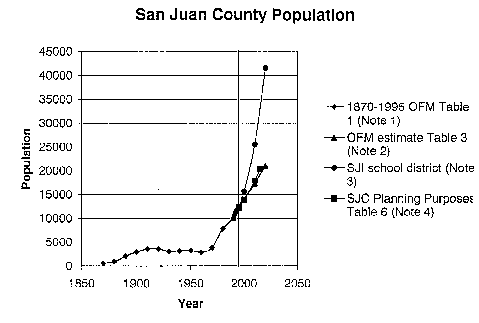
(Background Note: San Juan County filed a motion objecting to the introduction of this chart in the record, even though all the information that generated the chart was presented by the County in tabular form in an Appendix to the CP. The County clearly did not want people to see the graphic depiction of the growth of population over time. Their motion was denied by the WWGMHB; the graph was admitted into the official record. Perhaps as a gesture of defiance, the County refused to give the chart an official index number as ordered by the WWGMHB. They were subsequently publicly chided for their refusal to give the index number by the Western Board during the opening remarks of the Hearing as the Board announced its decision to assign its own index number to the chart.)
Parties Served:
A Declaration of Service accompanies this brief.
Dated this 7th day of May, 1999
Respectfully submitted,
Joe Symons